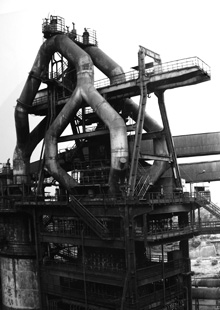
I have found some interesting case studies and information on the design of museums pertaining to the purpose and philosophy behind museum design, ways in which steel is used in contemporary museums, and instances of museums located on waterfronts.
In
Reshaping Museum Space, the authors discuss the purpose of museums. Different things they bring up:
- the museum should be built with the community's needs in mind
- which is more important, the "content" or the "container"?
- the museum should be a social and cultural symbol
- circulation should be carefully considered from the beginning
- the "majesty of the building [should] correspond to the importance of the production it holds...."
"Layer upon layer, past times preserve themselves in the city until life itself is finally threatened with suffocation: then, in sheer defense, modern man invents the museum."
-Quote from
The Architecture of the MuseumI think this quote is relevant to the Steel Museum because we are in a sense preserving an entire history of steel production in Pittsburgh that is quickly being encroached upon, and in danger of being forgotten. It is a big responsibility to capture this history that has had such a significant impact on the city in one building.
This brings up another issue--the idea of a museum "embodying" the essence of its purpose. The Jewish Museum in Berlin (image below), though criticized for this very reason, achieves this embodiment succesfully. Critics claim that the building puts the contents at an inferior level by overpowering the user and its exhibitions; however, what is succesful about the building, in my opinion, is that it captures the feeling of mourning, suffering, and loss in its jagged exterior and form.
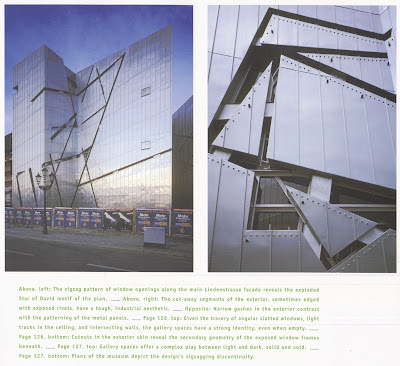
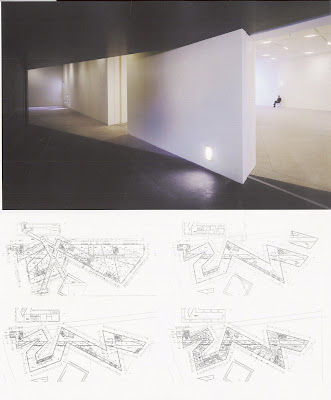 Jewish Museum-Berlin, Libeskind
One of the more relevant museums in terms of character I found was the National Museum of Science, Technology, and Industry in Paris, which is part of the Parc de la Villette.
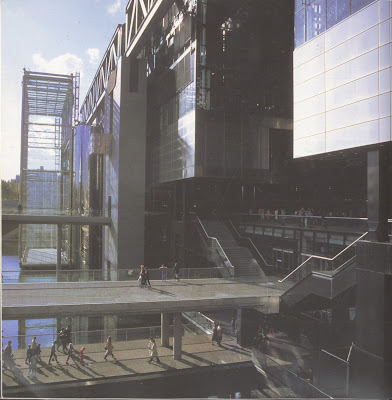
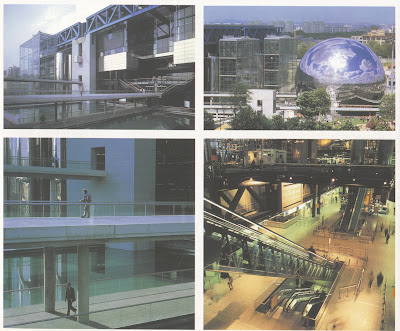
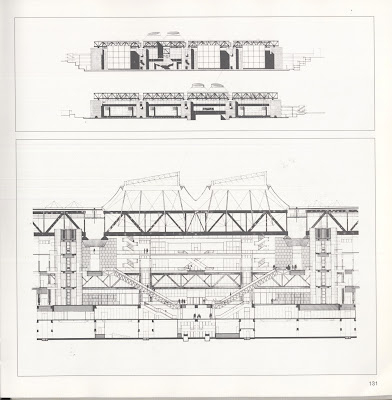
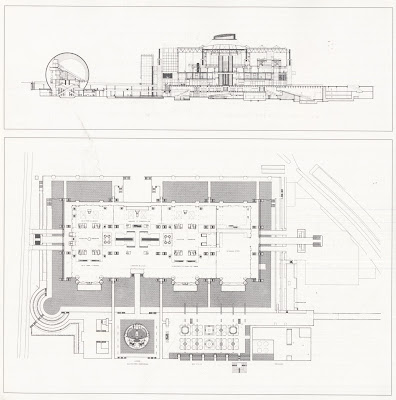 National Museum of Science, Technology, and Industry- Paris, Faisilber Architect
The Guggenheim in Bilbao is interesting in its existence as an iconic building on the waterfront and its relation to the urban fabric.

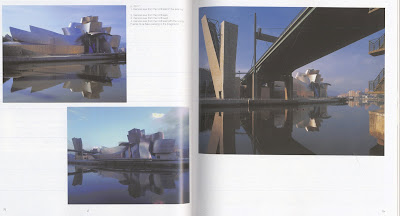 Guggenheim-Bilbao, Gehry
 Milwauke Museum of Art- Calatrava
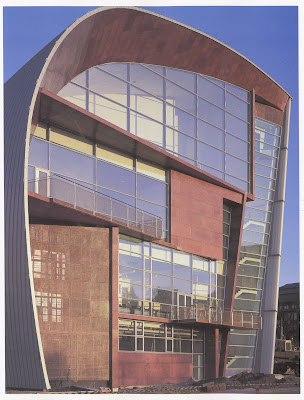 Kiasma Museum of Contemporary Art- Helsinki, Steven Holl Architect
 Modern Art Museum-Fort Worth, Tadao Ando Architect
Sculptural use of Cor-ten steel.
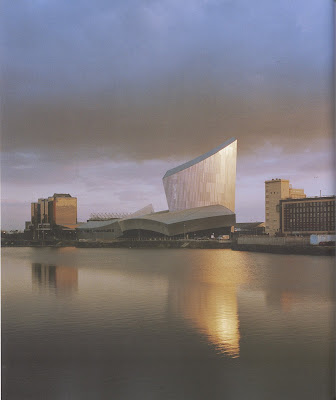 Imperial War Museum North-Manchester, Libeskind


 Image 1- David Lawrence Convention Center
 Image 2: Interior of the exhibition space
 Image 3: Exterior cables and masts