Showing posts with label site. Show all posts

Tuesday, January 30, 2007

History_The Site

in order to understand the site, we looked at the s history of the site as well as the way in which raw materials moved onto, through, and off the site.

1.0 site history
the history of the site begins in the 1890s with the construction of the carrie furnace. the development of the site can be traced from their with sanborn fire insurance maps, technical drawings of the site, and aerial photos. the series of images below show the known footprint of each building on the site placed on a conjectural aerial photo the attempts to represent the condition of the day.


1896 - the first two blast furnaces have been built


1901 - two more blast furnaces are constructed. the hot metal bridge is build to connect the carrie furnace with the homestead works.


1908 - blast furnaces 6 & 7 are built


1945 - the site is nearly fully developed. the river along the southeast corner of the site has been infilled


1956 - an actual aerial photo of the site with important buildings highlighted. the site was at its peak production during this period. the rankin bridge has also been constructed.


2007 - the site as it exists today. only blast furnaces 6 and 7 remain. the competition site has been highlighted.

2.0 site process
raw materials, namely iron ore and coal, where brought to the site. the ore was converted into steel and was then moved to the homestead works across the river was it was manufactured into a finished product.


step 1 - raw materials arrive on site


step 2 - materials are moved throughout the site on rail lines


step 3 - iron ore is stored in ore yards


step 4 - iron ore is taken to blast furnaces where it is converted to steel


step 5 - new steel is carried across the hot metal bridge to the homestead works. it is still glowing hot.


step 6 - the steel arrives as the homestead works where it final products are manufactured.

Wednesday, January 24, 2007

Thoughts_Site Visit

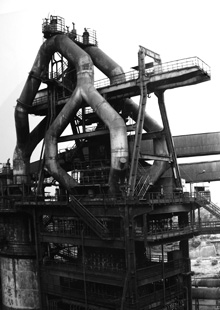
i felt that our trip to pittsburgh was very beneficial. it is nice to have an image of the site that we are designing for. the remnants of the carrie furnace were quite beautiful. the built-up of layer upon layer of growth was particularly intriguing to me. each component was designed an constructed without regard to aesthetics, but rather strict utility. interestingly, the combination of these utilitarian buildings and devices creates a very nice aesthetic.


img_1.1 - complexity of the carrie furnace

the 'waterfront' development was extremely disappointing. all the literature that i read about it praised it for its reuse and preservation of historic components. it was in reality just a strip mall on steroids. the historic relics were relegated to islands in the parking lot. there was no effort by the planners to situate these relics so that they could be engaged by the public. the series of smokestacks, which are a the advertised icon of the site and were purported to be the greatest achievement in preservation on the site were situated behind the movie theater (which was of course a giant metal building with a foam facade) and served only to bound the parking lot. again, there was no effort to create an area that visitors could occupy to experience these icons of the industrial age.

it was also interesting to see a steel factory that was still in operation, just slightly up the river from our site.


img_1.2 - the edgar thompson works

the city of pittsburgh, especially the downtown area, was also quite nice. i was intrigued by a local building typology: row houses made up of several very slender and deep buildings, all of varying height.


img_1.3 - downtown pittsburgh / rowhouses

the pittsburgh children's museum was a great building (not too related to our project). it was a very elegant reuse of historic buildings with a modern intervention.


img_1.4 - childrens' museum / rear


img_1.5 - childrens' museum / main entrance

Tuesday, January 23, 2007

Thoughts_Site Visit Reflection

I felt we had a very successful trip to Pittsburgh for our site visit this past weekend. While the competition package included some images, one really does not get the true sense of the area without visiting. The following panorama stitches are all of the site (which is the plot of land located between the remaining structures of the burn furnace and the abandoned bridge). Image 4 best describes the boundaries of the site. The trip helped to create a better idea of the greater context surrounding the site and has created a more tangible image in my mind of the area and surroundings.

The last two images are also very important because they represent another element that is critical to study during a site analysis--the surrounding architecture. These images attempt to capture the rich colors and textures of the vernacular architecture.


Image 1-View from NW corner of site


Image 2-View from East side of site


Image 3-View from bridge on East side of site


Image 4-View from North


Image 5-View of surrounding neighborhoods

Image 6-Example of local architecture

Thoughts_Pittsburgh Site Visit


Our time in Pittsburgh was a great way to get a feel for the site and the city. In exploring the areas surrounding the site, we found two contrasting elements: 1) across the river from the site is a new big-box mall development on the sites of old steel mills and 2) behind the site is a poor, somewhat run-down neighborhood of dense townhouses. I think it is essential that this context be taken into consideration during our design, primarily in considering the use of the building by the community for non-commercial and non-consumption based activities.

One thing I found interesting is that we will be incorporating visitors coming by car, boat, foot, and possibly by rail (a current conceptual proposal includes a monorail). This means that the building will be accessed from all sides. Also, the site is visible from almost every angle, making the site a prime spot for the landmark-building we will attempt.

Thoughts_Site Visit

The site visit in Pittsburgh was a success. We were able to access the entire site (a little trespassing never hurt anyone...) and photograph and view the site from some interesting angles. In my opinion, this or any project could never correctly begin without a site visit. Although a plan and some site photographs were offered on the competition website, it is necessary to experience a site in person to gain a worthwhile perspective.

Aside from visiting the site, spending some time in and around the city of Pittsburgh was helpful. Pittsburgh is separated into a handful of "boroughs" that all have a unique feel and terrain. Architecture is not only influenced by the site itself but also the urban fabric of it's surroundings and the general culture of a place. In particular, I found the remains of the Carrie Furnace to offer great insight to the industrial architecture that although no longer exists in Pittsburgh, played a significant part in the city's past.


Site and Carrie Furnace as viewed from across the Monongahela


Carrie Furnace